Thomas Reisenegger gives a fascinating and actionable overview of how to think about marketing indie games. Some principles are timeless; others are targeted to the current social media landscape.
My favorite insight (and one that has frustrated me when it isn’t followed) is that all your marketing should “work for the newcomers”. It’s important to remember that every post, trailer, etc. you make will be the first time a significant number of people will even hear of your game.
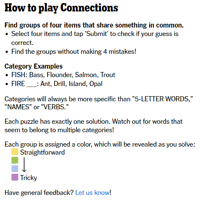
Raph Koster takes a look at Connections, the new daily puzzle at the New York Times, and delves into the design consideration of puzzles and puzzle games to explain why this one is perhaps less well-received than its predecessors like Wordle.
I found this very interesting, and it pulled into the light a lot of things I had only experienced as instinctive reactions. (Including how I felt about the similar earlier Red Herring.) (Plus I felt a bit vindicated by the fact that one of the things Koster calls out is one of my favorite hobby-horses: the game punishes you for trying to learn.)
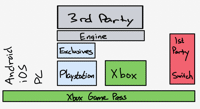
Ben Thompson summarizes the history business models of the most prominent game console makers, as background for discussing Microsoft’s ongoing attempt to acquire Activision Blizzard.
As someone who lived through most of this history but spent a lot of it too young to have the perspective to understand it, I found this look fascinating. The shifts in approach play out differently based on interactions with broader market trends in a way that reminds me a lot of competitive players adjusting to a shifting metagame.
Jaiden makes a lot of fun videos with a recent focus on obscure games or self-imposed challenges. In this one, she plays Super Mario World blindfolded with verbal guidance from a friend.
It’s amusing and entertaining like most of her videos, but it’s also fascinating to see where the difficulty spikes end up being with this approach. It reminds me of Razbuten’s “Gaming For A Non-Gamer” series, revealing surprising things about what makes a game hard if you have different constraints from the typical player.
Sam Barlow (of Her Story fame) discusses his approach to building stories for narrative-based games. I found it refreshing to see discussion of how the medium affects what’s possible and how to get the most out of it, by incorporating challenge, opportunity for expression, a space to explore, and simulation of a richer reality. (I couldn’t help but look for parallels to my own, far-less-qualified, take on the subject.)
We can argue all we want about the relative merits of closed versus open systems and so on, but it’s rare that this actually persuades any decision-makers. What they pay attention to is what’s been shown to make money. So it’s exciting that Valve is out here betting pretty big on releasing the Steam Deck as an open system and that they seem to be having success with it so far. If that success continues, then maybe the Nintendo/Sony/Microsoft/Apples of the world will start to take notice.
It’s also an interesting lesson on productization and marketing. All these unusual capabilities of the Steam Deck are really nothing new and have been available on general computers for quite a while. But by presenting the Steam Deck as primarily a Switch-like hybrid games handheld/console with buttons and analog sticks, giving it an approachable works-out-of-the-box setup and configuration, and pricing it affordably, it targets a new audience and is suddenly seen as a direct competitor in what had previously seemed like a different market.
In one of the frustrating ways art imitates life, games with systems resembling real estate tend to create situations resembling housing crises. In this write-up, Lars Doucet and Dan Cook discuss why this happens (hint: it’s the same reasons it happens in real life) and how to fix it in your game design (hint: it’s the same way we could fix it real life).
Super Bunnyhop contextualizes the recent large-scale game company buyouts by summarizing their history over the several decades the industry has existed and discussing the difference in how they are seen by insiders versus consumers.
We all know that there are a lot of Mario games. But how many games are there in the mainline Super Mario series? As jan Misali shows us, this turns out to be a difficult question to answer because of all the questions you have to answer along the way.
Some of the more-divisive ones include - is it still Super Mario if the gameplay changes significantly? Arguably, the New Super Mario Bros. games, which can be seen as their own side series, are more like the original Super Mario gameplay than, say, Super Mario 64 or Super Mario Odyssey. What about initial entries in sub-series spinoffs that are titled like sequels to mainline games, like Wario Land: Super Mario Land 3 and Super Mario World 2: Yoshi’s Island? And given the existence of enhanced ports and remakes, what even counts as a game? Is there a game called Bowser’s Fury, and if so is it an entry in the Super Mario series? It’s difficult to come up with a consistent set of definitions and answers to these questions that results in a list of games that feels correct.
To me, the main value of an analysis like this is as a reminder that categories are inherently slippery since they are more about grouping similar characteristics than hard and fast binary definitions, and furthermore that they can never really be true or correct - only useful. It’s something I try to keep in mind whenever people start arguing about genre definitions. Surely membership in a well-established game series is much simpler and more clear than membership in a broadly defined genre. If we can’t even agree how many Super Mario games there are, how can we hope to agree which games count as roguelikes? And if we can’t reach consensus on that question, then maybe it’s actually not that important.
Providing anotherreminder that gaming is bigger and more diverse than many of us think, Felipe Pepe sets out to examine the history and influence of RPGs in various countries, pointing out that “[y]ou hear all the time about how big Fortnite is, with its 30 million daily users…. and then you find that a game from Vietnam has 100 million daily players.” In this first installment of the series, he examines China.
Curation and discovery are tough problems for game storefronts. The easier it is for legit games to get onto a store and be seen by customers, the easier it is for asset flips, shovelware, and outright scams to do the same thing.
In this writeup, Chris Zukowski discusses several of the current trade-offs being made by the Steam store to combat the flood of fake or low quality games that came with Steam Direct replacing Steam Greenlight. It’s clear that the same barriers which make those games less viable on Steam also make small-scale, low-budget, but legit games less viable as well. It’s less clear whether there’s a better solution.
The therapeutic potential of video games deserves more exploration. In addition to games specifically designed to help deal with mental illness, games can provide safe ways for us to experiment with and overcome challenges that are harder to tackle directly in real life (as I’ve touchedonbefore).
In this insightful and deeply personal video, ShayMay discusses The Binding of Isaac within the context of his own difficulties with anxiety and how it served as a safe way to practice - and even learn to enjoy - not being in full control.
Most of us know that without a playable demo, marketing materials like gameplay trailers and development blogs aren’t always enough to answer the question of whether a game will be enjoyable. Ben Bayliss points out that for those of us with accessibility concerns the question can instead be whether the game is playable at all, making purchases much riskier.
Players approach in-game challenges in ways informed by what the game (and other similar games) have already taught them - in some cases, this can lead to missing seemingly-obvious solutions because the game’s affordances are pointing in another direction. (I ran into this during my playthrough of Right Click to Hack.)
This write-up illustrates that principle by taking a look at how playtesters approached a particular environmental puzzle in Immortals Fenyx Rising - and encourages designers to support more freedom and creative thinking in designing their challenges and to not be afraid of the opportunities this can create for “breaking” the game, as that’s often more satisfying for the player anyway!
Game designer kiva’s blog has some fascinating war stories. This particular write-up, part of a series about her work on Battletech, discusses her somewhat-failed attempt to create an event system that would create a bond between the player and their characters - what it tried to do, and why it didn’t achieve those goals.
If you find it interesting, I do recommend her other posts - she has fascinating thoughts on a game designer’s role (in a nutshell: empathizing with the players) and skill set (another nutshell: internalized understanding and intuition from deeply examining many games).
As I wrote about myself a bit recently, FarmVille’s impending shutdown closes the book on an incredibly influential game (for better and worse) and a huge part of gaming history. This article takes a closer look at FarmVille’s legacy, discussing its role in bringing games to mass market and early steps in metric-driven design and what we might today call loot boxes.
With so many quality games coming out all the time, the bar for success has raised considerably from where it used to be. It’s harder than ever to get and keep the attention of players, especially for indie developers. Here, Josh Bycer puts together a list of what he sees as the minimum requirements in game feel, presentation, and marketing for a game to succeed in the modern landscape.
Patrick Klepek explains how and why Grounded ended up with “Arachnophobia Safe Mode” as well as similar examples from Skyrim, Satisfactory, Sea of Thieves, and Cook, Serve, Delicious! showing how these kinds of accessibility features can open games up to audiences that otherwise couldn’t enjoy them.