Posts by Tag / Thought (335)

Quick, short, often niche posts about games. Sometimes they are brief looks at concepts in art, design, culture, and psychology. Other times they are reactions to specific news items or just something silly that came to mind.

A conversation between two designers for Danganronpa 2

| | 0 Comments

“You know how sometimes you’re trying to figure something out so you ask yourself a series of questions? But before you can ask yourself each question you have to imagine yourself skateboarding down a tunnel in space? And if you don’t skateboard well enough you run out of time and can’t answer your own question that you’re asking yourself?”

“…no. No, that has never happened to me.”

“Oh. Well how about that thing where someone asks you a question and you think you know the answer but before you can form the word you have to think of a bunch of random letters and pull out the right ones in the right order to spell the word? And sometimes you think of too many letters and they crash into each other and explode so even though you know the word you can’t say it and you stay silent so all your friends convict you of murder even though no one was even talking about you?”

“What? No! No, that has never happened to anyone, ever!”

“…oh. You’re not going to like what I spent today working on, then.”

The Platform is the Playstyle: Missing the Point

| | 0 Comments

So, while I love the Nintendo Switch, there is something about it that makes me sad: the death of pointer-based games on console and handheld.

In 2004, the Nintendo DS came out. At first, people didn’t know what to make of its touchscreen and stylus. It felt gimmicky. But then games like Trauma Center: Under the Knife, Elite Beat Agents, and The World Ends with You (to name just a few) showed us what you could do with it - things that you couldn’t do on any other game system. Then in 2006 came the Wii, showing that by using a Wiimote and sensor bar you could do the same things on a larger scale on your living room TV. Everyone talked about the Wii’s waggle, but the pointer was the real game-changer, as seen in games like Metroid Prime 3: Corruption (not to mention three more Trauma Center games). You could even play light gun games like Sin and Punishment: Star Successor or Resident Evil: The Umbrella Chronicles with no extra equipment!

In 2011 we got the 3DS, an improved DS that allowed for new experiments like Kid Icarus: Uprising and in 2012 the Wii U combined both the Wiimote/sensor pointer and the stylus/touchscreen pointer. Not only could the Wii U play its own pointer-based games and Wii pointer-based games, but through the Virtual Console it could play dozens of excellent DS games by using the TV as the top screen and the GamePad as the touchscreen.

But the Wii U failed, and the hybrid console Switch has replaced both the Wii U and the DS line. It technically has a touchscreen, but it’s easy to forget - most games don’t use it because it’s not accessible while the Switch is docked. The system doesn’t even come with a stylus.

As a result, an entire interaction style is lost to console games. To port any of these games to Switch would require completely reworking them for a very different experience. Sony and Microsoft never adopted these interaction methods on a large scale - Xbox had its own Kinect experiment, and PlayStation Move was never a major player. The only place you can find reasonable pointer-based games now is on PC via mouse, which is not quite the same.

I’ve written before about how the convergence of gaming platforms will mean more homogeneity of game experiences. This is why that makes me sad. There were some great games on DS, Wii, 3DS, and Wii U that are now unlikely to receive any real follow-up and will be increasingly difficult to find and experience as their native hardware ages out, and which can’t even be preserved via ports without losing a lot of what made them special.

#gaming #video games #games preservation #nintendo switch #wii u #wii #nintendo 3ds #nintendo ds

Tags: Thought, TOPIC: Preservation

Apple Arcade Seeks Engagement

| | 0 Comments

From Apple Cancels Some Arcade Games in Strategy Shift To Keep Subscribers:

“[Apple] scrapped development contracts with multiple game studios earlier this year . . . . [A]n Apple Arcade creative producer told some developers that their upcoming games didn’t have the level of ’engagement’ Apple is seeking. . . Apple is increasingly interested in titles that will keep users hooked, so subscribers stay beyond the free trial of the service. . .”

I was a little worried things would move in this direction, but was hoping they wouldn’t. As helpful as it is to set up an ecosystem where games can’t rely on IAP and developers don’t have to think about price, the subscription model does easily lend itself to optimizing for engagement, which causes its own problems.

I’m really hoping they’re at least looking for more complex metrics than just daily active users or something.

Clicker Heroes 2 isn’t for me... yet.

| | 0 Comments

I revisited Clicker Heroes 2 in Early Access now that they’ve replaced Gilding with Ascending to see if that addressed my concerns from before. And, I mean, it kinda does? Ascending still basically resets your skills in exchange for a damage multiplier, but you retain the stat boosts from most skill nodes and even a few of the abilities, so you can still make gradual progress in the direction of a particular build across multiple ascensions.

But I realized what the real problem is for me in Clicker Heroes 2 compared to my favorite idle games: you never get anything else to fill the downtime.

It’s common in idle/clicker games for your focus to sort of zoom out over time. At first you’re focusing on individual clicks or actions, then you’re focused on upgrades or automation, and so on. The time between meaningful choices gradually increases - you start out clicking near-constantly and eventually reach a point where it makes sense to put it down for minutes or hours and come back periodically to spend your accumulated wealth.

In some idle games, there’s something else to go do while you’re waiting for that wealth to accumulate - something that ties in to the economic systems but can be basically any kind of gameplay. Some of the most famous examples have been essentially roguelikes, there’s a dual-stick shooter and a town builder in my list of examples a couple paragraphs up as well.

But in Clicker Heroes 2, there isn’t something else. The thing to do is just - put the game down and come back later. And the only thing you do every time you come back is spend the wealth to increase the accumulation of wealth for the next time you come back.

This is kind of a weird thing to criticize since it’s basically the core loop of the genre, but for me it makes it hard to stay engaged. Spending a couple of minutes on upkeep just to make sure I’ll have something to spend a couple of minutes on again later starts feeling empty pretty quick. Once I’ve gotten to the point where I have an actual character build going, there’s no longer anything to sink my teeth into.

So if you start Xenoblade Chronicles: Definitive...

| | 1 Comment

So if you start Xenoblade Chronicles: Definitive Edition on a Switch where you also have a save file for Xenoblade Chronicles 2, you get an optional bonus: you can start the game with 100,000 G.

This kind of reward has always confused me. It’s not, like, a Rex outfit for Shulk or something, which is a pattern I’ve seen in other games that makes sense to me - a cosmetic reward that’s a nice touch for the people who can get it. Instead, it’s just a big pile of currency - which means this is a balance question.

Positioning the extra money as a reward implies they think the game is better if you start with it - in which case, why don’t you start with it by default? Or even if this is a case where some players would probably enjoy it and others wouldn’t, then why only give that choice to people who have already played a sequel to this game?

One way or another, I feel like the game has been (very slightly) worsened for one group or another in order to enable a reward that potentially has significant effects for early-game balance and pacing. I feel like the intentions here were probably good, but the results are just kind of weird.

Animal Crossing Trolls Focusers

| | 0 Comments

I wrote recently that players can be divided into “multitaskers” who don’t mind interruptive context-switching and “focusers” who find it disruptive and unpleasant. And now, just as I argued that Animal Crossing effectively trolls completionists, I’m going to argue that it also effectively trolls focusers.

Inventory limits and equipment durability are the most common way. Running out of pocket space while you’re in the middle of something (catching bugs, fishing, harvesting fruit, shaking trees, hitting rocks, etc.) is obnoxious in all the usual ways, interrupting your fun with a chore you now have to deal with before you can go back to doing what you wanted to do. But if you’re a focuser, you’ve also got the interrupted goal unpleasantly on pause in the back of your mind the whole time.

Equipment breaking is similar. If you lose your axe in the middle of chopping wood, or break your pole while fishing, or break your shovel while there are still rocks to hit, or whatever, now you have to run back to a crafting station (and possibly home to your storage if you aren’t keeping materials elsewhere) and craft a replacement before you can continue (and man is it frustrating to see a rare bug while you have no net or a balloon gift while you have no slingshot). Though in some ways it’s even worse than the inventory problem, because there are no visible durability meters and unless you’re keeping careful track of your tool use it’s hard to predict when one will break. You can craft and carry extras, but tools don’t stack so doing this means you’ll run out of inventory space more often, and you’re just trading off one interruption against another.

On top of this are the mid-scale daily activities - digging up four fossils, hitting six rocks, talking to ten villagers, shaking every tree, etc. It’s very easy to get interrupted while doing this - maybe you’re shaking trees when you see a balloon gift, or you’re running from rock to rock when you see a fast-flying bug and need to chase it around. Making sure you talk to each villager every day is perhaps the hardest one since they wander around unpredictably and it can be hard to keep track of who you’ve found so far.

Again, if you’re a multitasker this probably won’t bother you, but if you’re a focuser it’ll be frustrating to keep in your head who you’ve talked to and which rocks you’ve hit and how many fossils you’ve found. For the first weeks of my time in New Horizons, I found that this led me to do things like a “rock pass” and a “tree pass” over my island during which I focused fully on that goal, not letting myself get distracted and sometimes literally writing down which villagers I’d seen and which I still needed to find. It turned the game from one I could relax with into one I had to pursue with dogged focus until I finished the once-a-day tasks.

Eventually I realized that there are mobile apps that allow you to create daily checklists prepopulated with the common tasks so you can just keep the app open on your phone and tap the villagers as you talk to them and so forth. This lets you offload the mental overhead of keeping track of those things and just relax and enjoy.

It would have been fairly easy to include this sort of functionality directly in the game itself, where it could auto-update and be even easier and not require separate hardware. It’s not uncommon for games to have that sort of tracker. It seems likely to me that Animal Crossing’s designers deliberately chose not to include it (and continue making that choice with each sequel). For multitaskers, such a feature would probably feel like it was pushing the player into completionism and away from just relaxing and enjoying the game - while the very presence of that feature is required for focusers to relax and enjoy the game.

Multitaskers and Focusers

| | 0 Comments

I’ve written a few times about the idea that a lot of debates about game design actually come down to poorly-understood differences in how our brains are actually wired. I think I’ve found another example.

Games often ask the player to context-switch - to go from one type of task to another with different relevant considerations. But there’s a difference between context-switching because you finished a task and doing so because you were interrupted.

Suppose you’re playing a dungeon crawler or looter shooter or something where you fight your way through a dungeon and return to town to sort/sell/upgrade the loot you earn. These are different experiences - combat and exploration, followed by upkeep and optimization. They require you to focus on different things. Which parts of the dungeon you’ve explored and how much ammo and health you have left matter a lot in the dungeon, but back in town you’re concerned more with stats and currency.

If you finish the dungeon and then go back to town to sell, you can safely stop thinking about the dungeon’s concerns. They need no longer take up any mental resources. But if you are partway through the dungeon and then need to return to town because your inventory is full, you aren’t done worrying about which parts of the dungeon you’ve explored and how many enemies remain. You can’t forget about those things even as you must start focusing on equipment and currency instead for a while. They’re just temporarily on hold, like a mental equivalent of leaving a bunch of browser tabs open as you switch to something else as opposed to finishing a project and closing them all.

For some players (whom I shall tentatively call “multitaskers”) this is fine. For others (tentatively “focusers”) this can be deeply unpleasant. A focuser doesn’t like holding context in background memory. It’s difficult and distracting.

This is why when Torchlight adds the ability for you to send your pet back to town to sell things without having to leave the dungeon yourself like you have to in Diablo, some players love that this keeps you in the action while others lament that this disrupts pacing and removes breaks. If leaving the action means you’re preoccupied with an unfinished task the whole time, it’s not much of a break at all!

I am a focuser, and much like the fact that I am a completionist this has a significant effect on how I feel about certain game design choices. In fact, I think they’re connected - there’s a lot of overlap here with my claim that completionists feel anxiety about tracking long-term objectives. Both a focuser and a completionist as I’ve described them want things like a quest log or map icons to keep track of those objectives so that the player doesn’t have to keep them in background memory - if that task can be offloaded because it’s written down somewhere and automatically updated, then the player doesn’t have to spend continual mental resources on it. They can close the mental browser tabs.

As implied above, I think this is also a big part of why I dislike inventory limits that interrupt you with sudden mandatory inventory management, which has turned me off several games over the years.

And it’s likely also connected to my general dislike of punishment, particularly of the “you died on the boss so replay the level” variety. I want to immediately retry whatever it was I failed on, because holding the details of that challenge in my head while I fight my way back through other challenges is frustrating and unpleasant. The need to do so has also turned me off of a number of games over the years.

#gaming #video games #neurodivergencies #completionism #inventory management #torchlight #punishment

Tags: Thought, TOPIC: Completionism

Animal Crossing: Losing Interest

| | 0 Comments

In the version 1.2.0 update for Animal Crossing: New Horizons, the interest earned on banked bells was drastically reduced - per Kotaku, “[t]he previous rate was estimated at around 0.5%. Now it appears to be closer to 0.05%, with interest payouts capped at 9,999 bells.”

Perhaps unsurprisingly, Nintendo isn’t being especially transparent about this. The in-game notification doesn’t even say what the interest rate used to be or what it is now, and there has been no public statement about why the change was made. In the absence of any other explanation and with Nintendo’s established patterns, the natural assumption is that the change is intended to handicap “time traveling.” Players who mess with their Switch’s internal calendar in order to earn a bunch of bells quickly through accumulated interest will now only earn about a tenth as much.

Like most cases of forcing a playstyle, this strikes me as misguided. Making this method earn money more slowly isn’t going to make playing without time travel more appealing. Players who time travel are already opting out of the way Nintendo wants them to play - now they just have to go through more tedious steps to play the way they actually want to play. Meanwhile, the players who aren’t time traveling are also punished by this change, with one of the game’s approved methods for earning bells being reduced in effectiveness by ninety percent! If anything, this change punishes the people playing the “right” way worse than it punishes the time travelers!

It’s a small thing in the grand scheme - from money rocks and money trees alone, you can easily earn tens of thousands of bells per day of actual play. But it bothers me that Nintendo would - apparently - hobble one of the game’s many fun details in an attempt to punish people for enjoying it “incorrectly” and as a result make things a little bit worse for everyone.

Why is fishing so hard?

| | 0 Comments

Does anyone else find it weird in Animal Crossing how much harder fishing is than, like, anything else?

Even videogamedunkey pointed this out.

I’ve been thinking about this a lot because the mechanics are pretty simple and on paper it’s not obvious that fishing would be more difficult or frustrating than, say, catching bugs. But there actually are several key differences.

First is that unlike bugs, which you can see before deciding to try to catch them, you can never be sure what kind of fish you’re trying to hook. It’s limited to some varieties by time and location, but beyond that all you have to go on is its rough size. You can run past the bugs you don’t need and only target the ones you’re specifically looking for, but if you’re looking for a specific fish you have to go for any shadow of the right size in the right place at the right time, with no guarantee that it’s the one you need - or even a fish, as it can turn out to be trash instead (or, during the Bunny Day event, a candy egg). So even if you succeed at the actual fishing challenge, you might not get the reward you want. And any fish that gets away might have been your one chance at the rare fish you’re seeking.

Next is the first stage of the actual challenge: getting the fish’s attention. Using the fishing pole casts the bobber out a set distance in front of you, and this can be bizarrely hard to aim. You don’t get any control over where it goes besides pointing your character in a direction, which can be difficult to do with precision. Fish have a surprisingly small area that they pay attention to and they can move around and reorient randomly. As a result, you may have to cast several times to actually get noticed - many times, I’ve cast my bobber only to have the fish turn around while the bobber was in midair. But you have to be careful about reeling the bobber in for a recast - if you do it when the fish actually had noticed it, the fish vanishes.

Finally comes the main challenge: reeling in the fish. The fish will nibble at the bobber zero to four times and then bite it. If you pull the line in any time before the bite, you lose the fish. Once they bite, you have a short window to pull the line in - hit the button too late, and you lose the fish. The window might be shorter for more rare fish, but in New Horizons you can’t tell from the shadow whether the fish is rare so you must treat every fish as rare. Either way, it’s a shorter window with less player control than almost anything else in the game - the only other thing I can really point to is dealing with wasps, but those have multiple mitigating factors (if you’re trying to catch them, you get several chances a day; if you fail to avoid them you can just take medicine which is easily acquired).

Fishing, like catching bugs, is one of the most prominent activities that you’re generally expected to do every day. It’s really odd to me how much harder and more frustrating fishing is than all the other prominent activities.

Animal Crossing Trolls Completionists

| | 0 Comments

I wrote recently about dividing gamers into “completionists” who want to master a game and not miss anything and “wanderers” who want to explore a game and find surprises. Game designs can be good for one group and bad for the other, or can try to find compromises.

Animal Crossing is very much designed to appeal to wanderers, to the point where it almost comes across as purposefully trolling the completionists.

Animal Crossing wants you to slow down and relax. It isn’t designed to be binged - it doles out mechanics slowly, limits what you can do in a day, and adds in overnight delays to encourage you to come back tomorrow. The game actively resists players who want to power through its content, offering its best experiences to those who just check in for a while once or twice a day.

And that’s fine, even if it’s not how I normally play games since I like to progress on my own schedule, not someone else’s. I have to remember to get in the right headspace for the game, but then I can have a good time. The problem is that Animal Crossing also has several mechanics that make it very hard to stay in that headspace.

If you’re a wanderer who naturally approaches games in a relaxed, open-ended way - then you’re fine. But if you’re a goal-oriented completionist then Animal Crossing is actually a bit of a minefield, primarily through having checklists of goals with time-limited availability. Such as the stringfish.

See, there’s quite a variety of fish you can find in Animal Crossing. They vary by time of year, by time of day, by body of water, and sometimes by weather. On top of that, they have varying levels of rarity. The stringfish, for example, can only be found from December to March, from 4 pm to 9 am, in elevated rivers, and even then it’s quite rare. You can do everything right - stock up on fish bait (which is tedious, as you must hunt manila clams and then craft them into bait one at a time), head to a clifftop river at the right time of day during the right month, catch dozens or even hundreds of fish, managing your limited inventory and breaking fishing poles along the way, and never get a stringfish.

It might seem clear that this is the wrong way to play. It means a lot of time spent doing things that are tedious and stressful instead of relaxing. Clearly it would be better to just do some fishing here and there when you’re in the mood, and if/when you finally do catch the stringfish it’s a pleasant surprise.

Except. EXCEPT. There’s a museum. The museum lets you donate one of every fish, bug, and fossil you can find, displays them in somewhat spectacular fashion, and rewards you for completing a collection. The museum turns fish into a checklist and stringfish is absolutely on that list. And Animal Crossing released on March 20, less than two weeks before stringfish became unavailable for nine months. Is it any wonder that some players felt pushed to try hard to get the stringfish before the month ended - and then felt aggravated when they put in a lot of time and effort and still didn’t get the damn fish?

This is my problem with Animal Crossing. It provides experiences that are best enjoyed in a wanderer-style way, and then includes mechanics that encourage completionists to approach the game in a very different way that’s much less enjoyable. It’s sort of the completionist’s fault that they are playing the game wrong, and it will especially seem this way to wanderers who fall naturally into the better ways to play. But the game could do a lot more to lead more kinds of players into its best experiences.

Here’s another example that’s new to New Horizons: tool durability. When building most tools (shovel, fishing pole, bug net, etc.) you first have to build a “flimsy” version from common materials. This version is only good for a small number of uses before it breaks. You can also build a normal version of the tool, which takes the flimsy version and a slightly rarer material. This version lasts many more uses.

Here’s the thing, though - going from the flimsy to the normal version doesn’t add uses. It sets them to a higher number. That means that the most efficient use of your materials is to use the flimsy version almost enough to break it and then upgrade it to the normal version.

That’s already a kind of obnoxious thing to do, but on top of that tools don’t have a visible durability meter. So if you do want to optimize this, you have to learn how many uses a tool has and then keep count per tool. Undercount and use it too many times before upgrading and it’ll break instead; overcount and upgrade early and you’re missing on potential uses - either way, you waste crafting time and materials.

Now, I think it’s fair to argue that you aren’t supposed to try to optimize this way. Many players will just craft the flimsy version and the upgrade in one go and not worry about the “wasted” uses and probably have a better experience. But here’s the thing - the game could have easily catered to both types of players. If the upgrade added uses instead of resetting them, it would always be correct to just go straight for the upgrade and all the players would have the better experience.

By not approaching its design in this way - by not setting things up so that the mechanically optimal way to play is also the most enjoyable way to play - Animal Crossing is actively setting traps for players who want to optimize. The game is designed to be maximally enjoyable if you approach it as a relaxed experience but has mechanics that cause certain kinds of players to not be relaxed.

Completionists and Wanderers

| | 0 Comments

There are a lot of ways players differ, but one frame I’ve been thinking about a lot is the spectrum from being what you might call a “completionist” to a “wanderer.”

Completionists are goal-focused. They want to understand a game’s rules, master its mechanics, and conquer its objectives. They don’t want to miss anything.

Wanderers prefer to explore and experiment. They like surprises and like to feel like a game’s world is organic and huge - perhaps bigger than can ever be fully understood.

Most players are somewhere in between. I personally am pretty far on the completionist side. While there certainly are games that can appeal to players regardless of their position on the spectrum, many design elements will hit players differently - the point where “good design” for wanderers can be “bad design” for completionists and vice versa.

For example, I’ve seen a lot of people complain about the fact that in open-world games in the Ubisoft formula, you end up with a huge checklist of map icons instead of a world to explore. These people tend to also celebrate the approach used by The Legend of Zelda: Breath of the Wild which doesn’t give you much in the way of automatic icons, instead tasking you with looking through binoculars and marking points of interest yourself. To wanderers, the latter feels more like actual exploring and is far more satisfying. To completionists, it can be nerve-wracking - it puts all the pressure on the player to notice and keep track of everything (I’ve even seen reviews suggest playing with a notebook and maintaining a to-do list) lest they miss something.

This can pose a challenge when designing games for large audiences and there aren’t always viable compromises. I find that what helps me a lot is having some kind of safety net: if there’s an unobtrusive checklist tucked away in a menu or something, such that I know I can always check in on it and be sure I’m not missing any objectives or sidequests, then the pressure is off and I can stop worrying and can actually enjoy exploring. But I’ve also seen people (who are presumably far on the “wanderer” side of the spectrum) complain that the mere presence of checklist features, even optionally, can ruin the feeling of free exploration.

One of the absolute best implementations of a completionist safety net I’ve ever seen comes from inFAMOUS 2. Both of the first two inFAMOUS games feature hundreds of collectible “blast shards” scattered across the games’ respective cities. Collecting them increases how much energy you can store, but you don’t need all of them in order to max out. But there is a trophy for finding them all. And unless you keep careful track as you play, if you find yourself with 349/350 shards in the endgame you have no recourse but to scour the entire city for that last damn shard. Not a big deal to wanderers, but potentially infuriating for completionists.

inFAMOUS 2 had a similar setup, but with a simple addition - a late-game optional upgrade that let your map radar always point you in the direction of the nearest shard. It’s such a minor change and it doesn’t disrupt the game’s balance, but it’s a lifesaver if you find yourself in the position of missing one or two shards at the end. Knowing this is there, you don’t have to worry about keeping track of the shards you do collect. You can just play the damn game.

And that, I think, is key to the difference between wanderers and completionists. To a wanderer, a completionist might seem like someone who should just relax and enjoy the game. But the completionist might be wishing they could do exactly that! They don’t choose to have anxiety about missing content. And a couple of simple accommodations can usually cut out that anxiety and let the completionist enjoy the game just as much as the wanderer.

Fickle Neighbors

| | 0 Comments

I appreciate the increased control Animal Crossing: New Horizons gives you over building placement - in New Leaf, I once had a new villager move in right in front of the plot I’d designated for the coffee house, nearly blocking the door, and it was frustrating that I couldn’t do anything about that.

But it seems bizarre to me the way the game still gives you almost no control about who moves out of your town. There are (largely-hidden) friendship levels with the villagers, but they don’t matter for this - periodically, a villager will ask you if they should move out, but which villager does so is random and cannot be influenced by the player.

In New Leaf, I consistently favored the villagers I liked and ignored the ones I didn’t, and the only villagers who ever suggested moving out were the ones I’d been favoring. Eventually, after a week or two away from the game I found that my favorite villager had moved away, and that’s when I stopped playing.

So far I’ve been playing New Horizons every day, so I don’t have a sense of how much of a risk this is here, but the first villager to ask about moving out was again my favorite one, which does not bode well.

It’s frustrating and I don’t understand it. It seems like it would only improve the simulation as well as the player’s enjoyment to let them influence who stays and who leaves. I’d like to be able to give presents to and do favors for particular villagers and then be reasonably confident I can safely put the game down for a while if I need to without losing my favorite neighbors. Surely it makes sense for villagers to want to stick around if they are good friends with the player?

Crafting a Regression

| | 0 Comments

Not long ago, I wrote that I hoped that Animal Crossing: New Horizons’s crafting mechanics might mean a less random progression in available furniture, and this has turned out to be only a little bit true. You quickly get access to a couple of basic furniture sets based on wood and iron but that’s as far as it goes before becoming random again - because the crafting recipes themselves are doled out mostly at random. So you still can’t really plan a particular aesthetic or take steps toward decorating your house that way.

Perhaps the most annoying example of this I’ve seen so far is the ironwood kitchenette. I’m decorating a kitchen now, I really want to use this particular piece of furniture, and I have the recipe for it. But I can’t make it because it requires two other pieces of ironwood furniture for which I don’t have the recipes - and I am far from being the only person in this situation. All we can do, apart from begging strangers on the internet for trades, is hope we randomly receive those other needed recipes.

I don’t know the reasoning behind this decision. This is now worse than the old random distribution - it’s random distribution with randomly distributed prerequisites. In the old games, I could at least just find a kitchenette without also first needing to find two other specific pieces of furniture before I could use it.

Dear Animal Crossing villagers,...

| | 2 Comments

Dear Animal Crossing villagers,

When I take the camera out, STAY WHERE YOU ARE. I want to take a picture of you being adorable because you are singing by the pond or sitting under a tree or resting on the hammock I put next to the bonfire. What I do not want is to spend a few seconds lining up the shot only for you to get up and walk behind a building. STOP DOING THAT.

Your pal,
The Resident Representative

DualSense is a Privacy Risk

| | 2 Comments

Sony have announced the PlayStation 5 controller - rather than being called the Dualshock 5, it will be the DualSense. An apt name, considering its main new feature is “a built-in microphone array.”

The responses I’m seeing to this so far are universally positive. I guess people like the idea of not needing a headset for voice chat. I’m much less optimistic about this - to be fair, I don’t do much voice chat in console games, so it wouldn’t matter much to me as a convenience feature, but I also find it hard to imagine it working well. How would a microphone in the controller pick up voice while not also picking up the TV, the button presses, and ambient noises?

But let’s assume Sony has somehow solved those issues and this actually works well as a replacement for a cheap headset like the one bundled in with the PS4. I still don’t want it. The nice thing about a headset is that you decide when to have an active microphone. You decide when it’s plugged in or disconnected, when it’s turned on or off. A microphone built into the controller is just always there and you don’t have control over it.

In an era where we have legitimate concerns about being spied on by our phones, home assistants, and other smart devices, we don’t need to worry that our game consoles have joined the club.

Thankfully, the reports so far indicate that the DualShock 4 will be compatible with the PS5. I’ll continue to use mine. I won’t use a DualSense unless there’s a way to physically disable the microphone.

Super Mario Chess Set

| | 0 Comments

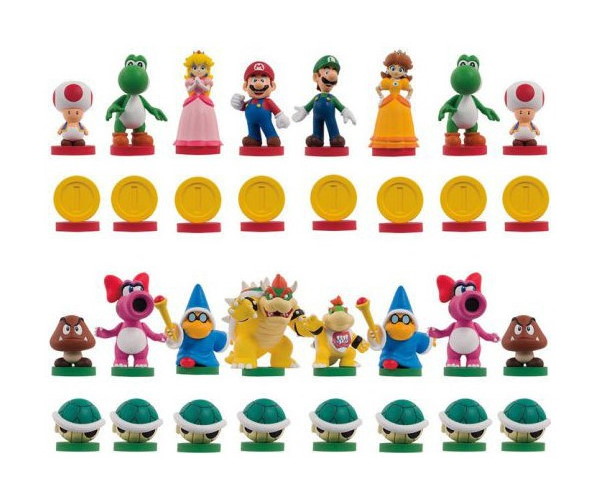
So, there’s a Super Mario chess set that’s been out since 2009. These are the pieces:

Image of Super Mario chess set pieces described below.

On the hero side we have Mario as the king, Luigi as the queen, Princesses Peach and Daisy as the bishops, Yoshis as the knights, Toads as the rooks, and coins as the pawns. Coins?

On the villain side we have Bowser as the king, Bowser Jr. as the queen, Magikoopas as the bishops, Birdos as the knights, Goombas as the rooks, and green shells as the pawns. Shells?

I look at this setup and am immediately disappointed. Surely we can do better than having uninteresting inanimate pawns? But I’m actually having trouble figuring out a better setup.

See, this does appear to be following some valuable constraints. For one, there’s no characters from related sub-franchises involved - characters like Donkey Kong or Isabelle or an Inkling who make sense in Smash Bros or Mario Kart but aren’t primarily Mario characters. For another, only characters who have sometimes been portrayed as a race rather than an individual (Yoshi, Toad) may be doubled-up.

I’m not sure how to avoid uninteresting pawns while keeping those constraints satisfied, having all the pieces be somewhat intuitive, sticking to the hero/villain divide, and only using important/recurring characters.

Like, I’d definitely argue that Toads are frequently portrayed as hapless villagers and would make perfect sense as pawns. But then who should the rooks be? Rosalina and Pauline are both reasonable adds, but keeping track of which of the ladies in dresses are bishops and which are rooks could be confusing. Poochy is a natural rook, but he’s from a sub-franchise. There’s Toadette, but then keeping track of rooks versus pawns gets confusing.

The villain side doesn’t really have this problem. You could easily make Goombas the pawns and Koopa Troopas the rooks, for example. There are so many enemy types to choose from (I might vote for Boos over Magikoopas for bishops, for example). But if the hero side has inanimate pawns, it seems wrong for the villains to have living ones. Maybe the green shells are their pawns because the coins are the hero pawns.

I can’t come up with a solution I’m happy with. How would you fix this chess set?

#gaming #Super Mario #chess set #video games

Tags: Thought

Nook Miles+ and Binge-Playing

| | 1 Comment

Animal Crossing games have always had a soft limit on how much you could do in a single day. Fossils only show up once a day, trees can only be shaken once a day, flowers can only be watered once a day, and so on - plus many event triggers (such as house expansions) have built-in overnight delays, so even once you hit one of these goals you can’t move forward past it until the next day.

You always could keep playing, catching more bugs and fish and picking up more shells, but at that point you’re mostly farming Bells. It’s an option, but it’s not where the game’s best experiences lie and I don’t think it’s what the designers really want the player to do. It’s possible because none of the mechanics forbid it but they don’t particularly reward or encourage it either.

Because of this, I’ve always gotten the impression that Animal Crossing wants to be played a little every day. You can choose to binge it and try to play as efficiently as possible and rush the various objectives, but the game neither encourages nor supports this approach. It’s designed to be less fun for players who come at it like that. It’s designed to slow you down. It wants to be a Zen garden, not a checklist.

New Horizons adds a fascinating feature that runs somewhat counter to this - the Nook Miles+ program that comes pretty early in the story progression. At all times, you have five mini-quests active that reward Nook Miles (a secondary currency alongside Bells) when completed and instantly replace themselves with another objective. These are things like catching five bugs (or five fish, or one specific bug or fish), spending Bells, selling items, crafting items, tending flowers, and so on - things that are very much in the “things you were probably going to do anyway” vein and often things that also earn you Bells along the way.

What this means is that even once you’ve done all the significant things you can do in a given day, you constantly have a short checklist of directed activities. You always have goals to accomplish for rewards. In some ways, it feels like a very non-Animal Crossing concession to players who want to binge and clear checklists. You can keep playing and knocking out more and more goals.

But at least in the early game, it seems to be less rewarding than it first appears. At the very beginning, Nook Miles are incredibly valuable - they’re how you repay your first debt and progress the game to unlock more mechanics and activities, and they can be spent on some absolutely vital purchases like an increase to your inventory size and a tool quick-select ring. Once you get through those things, though, there’s much less to do with your miles, at least in the early game. They still have some use and value, but at this point I have tens of thousands of miles just sitting around so it’s hard to find the Nook Miles+ objectives particularly compelling. I’m back to feeling like the game wants me to put it down until tomorrow.