Posts by Tag / Thought (335)

Quick, short, often niche posts about games. Sometimes they are brief looks at concepts in art, design, culture, and psychology. Other times they are reactions to specific news items or just something silly that came to mind.

A Few Tips for Dragon Quest Builders 2

| | 0 Comments

There are several useful things to know in Dragon Quest Builders 2 that the game doesn’t really hint at so you wouldn’t even know to try to look them up. I’ve collected a few that I stumbled on here. I expect there are more.

Apart from the first one, they are mostly for the late-game or post-game so they include some structural/mechanical spoilers. Consider yourself warned.

Read more...

Literal and Figurative Walls in Dragon Quest Builders 2

| | 0 Comments

I’ve been thinking a lot about the fact that you can’t have a fully-safe base in Dragon Quest Builders 2 while you’re doing story stuff. I noted before that this led me to rush the story bits, and got a comment saying “…I just stopped trying to make things look nice and tried to get things done faster I can get to building again”. So why does the game do this?

We don’t know the designers’ intent, but my theory is that this is about forcing a playstyle. (I actually wrote that article because I wanted to explain the concept so I could use it in this very conversation.) That article explains in more depth, but the basic idea is that a game’s designers notice that the game’s incentives are motivating players to behave in ways that don’t seem fun, but rather than change the incentive structure they simply block off or discourage the behavior they don’t want.

If this is what happened here, then presumably it went something like this: Random attacks were put in the first Dragon Quest Builders so that players would have to regularly defend their bases in order to create tension/pressure and leave the player feeling like an active protector. But in practice, a lot of players just built unbreakable defensive walls around their base, removing much of the tension and making it possible to almost completely ignore the random attacks. This also created a weird design constraint that made all bases look more alike, look less like they organically fit into the landscape, and have worse views of their surroundings.

They wanted to avoid this for Dragon Quest Builders 2. But instead of digging in to understand why players were building these walls and find ways to remove the need for the walls, they just made it so enemies could break through anything the player could build. They didn’t remove the motivation for using the strategy - they just made it so the strategy no longer worked. This meant that any player who had chosen to build the walls in the first game would probably still want to in the second game to solve the same problems, but now wouldn’t be able to solve those problems at all. It’s like the designers are saying, “Come on, you’ll have more fun if you fight enemies a lot!” and some of us frustrated players are left saying, “Did it occur to you that maybe I bought your building game because I wanted to build?”

Again, I don’t know that’s why this happened, but the outcome is the same regardless. Uninterrupted building time is positioned as a reward for completing story arcs - and in fact, once you finish the whole story you get the ability to craft an item that completely prevents monsters from spawning. So those of us who want to build uninterrupted used to be encouraged to build a wall; now we’re encouraged to rush the story instead.

For me, this makes the game worse. By far the biggest reason I enjoy the Dragon Quest Builders over something like Minecraft or Terraria is the context provided by the story and characters. That gives me a reason to build that isn’t really present in those other games. And once the story is finished, that reason mostly vanishes. The characters are still around, but they’re harder to stay invested in when they just cycle through a few lines of dialog and no longer have any goals or concerns.

In the first Dragon Quest Builders, one of my favorite things to do was to take a break from the action mid-chapter to redesign or improve my town. When I tried to do that in Dragon Quest Builders 2, it was an exercise in frustration as I was continually interrupted and often had to take extra time to perform repairs as well. So I stopped doing it and rushed the story - and then once I had uninterrupted building time, I no longer felt like there was a reason to improve the town. So I didn’t bother - and one of my favorite experiences in the game was just gone.

So what would it look like if the designers had instead modified the incentive structure so that players no longer felt encouraged to build walls? I can’t speak for every player, but for me I think the real problem is repairing. Repairing is time-consuming without being creative and to someone with my completionist/perfectionist/vaguely-OCD-like tendencies, the possibility of missing a couple blocks or items somewhere along the way (which absolutely happened in the first game) drives me batty. Attacks make me anxious because they create the possibility I’ll need to repair - if that were removed, they wouldn’t really bother me. (My evidence for this is a bit in Chapter 3 where the base gets attacked by enemies that can’t be kept out - once I realized they also couldn’t break anything, I stopped panicking when they showed up.)

In Dragon Quest Builders 2, villagers have the ability to build to a blueprint and to repair your base after story battles. If they could also repair after random battles, I think that would basically solve the problem for players like me. The attacks would still create tension and pressure and an opportunity to actively defend your base and people, but you wouldn’t be punished if you choose not to immediately drop what you’re doing and rush to handle it.

I’d definitely want to do some playtesting if I were actually in charge of a decision here, but my instinct is that this would be a better experience for everyone.

My Nintendo Selling Ads for Ice Cream

| | 0 Comments

I’ve mostly become numb to the huge pile of wasted potential that is My Nintendo, but they’ve managed to surprise me today. The North American reward store is now selling advertisements for an ice cream store. They want you to spend platinum points to buy these.

The only reason I can imagine anyone buying these ads is because there’s basically nothing else to spend the points on and they expire obnoxiously quickly (in a loyalty program!).

It’s always frustrating to watch Nintendo let good ideas languish, but this is actually straight-up insulting. I almost want to just skip ahead to when they inevitably shut the program down.

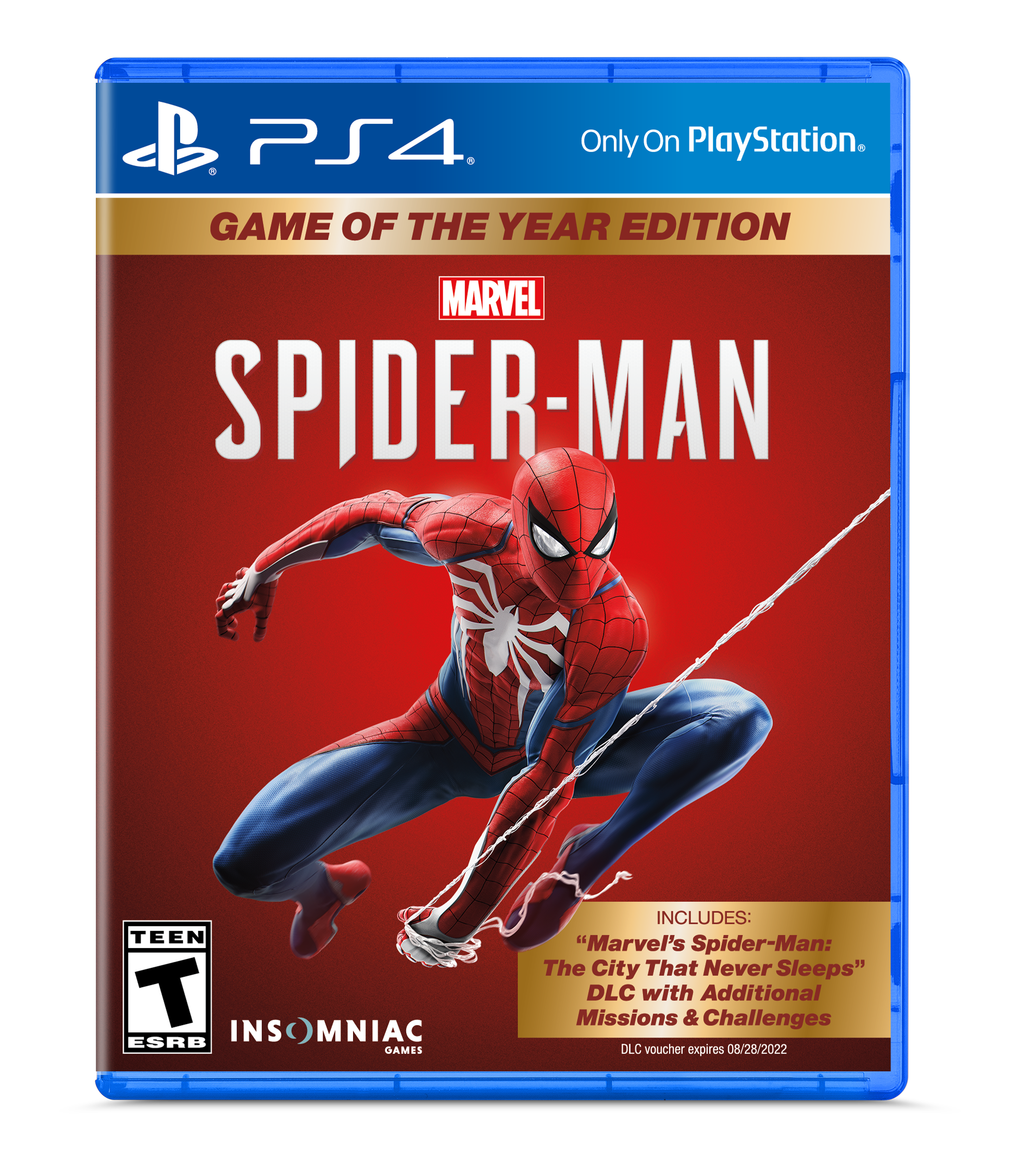
Marvel’s Spider-Man: Game of the Three Years Edition

| | 0 Comments

It’s not just patches that devalue physical media. Game of the Year (GOTY) bundles that include DLC via vouchers do it too.

Marvel’s Spider-Man was released by Insomniac nearly a year ago as of this writing, and it’s received a number of patches, free content updates adding new costumes and such, and three chapters of story DLC.

A Game of the Year edition bundling the DLC was announced a couple of days ago. But rather than re-press the discs with all the updated content present, it looks like it’s the same disc as always, along with a voucher for the DLC.

So anyone buying this “complete” game has to enter a code into the PlayStation Store and wait for the DLC to download. (I assume the updates as well; if they didn’t re-press the discs for the DLC I doubt they would have for the free updates.) They won’t be able to re-download any of this when the store’s not accessible.

And my favorite part? The cherry on top? There’s a tiny disclaimer in the bottom-right corner of the cover reading “DLC voucher expires 08/28/2022”.

The voucher expires after three years. There could certainly still be copies of this on the shelf then - this is the game used to sell the PS5’s performance, after all. Any copies of this bought after that point ARE JUST THE BASE GAME.

Dragon Quest Builders Sequel Wish List

| | 0 Comments

After I played Dragon Quest Builders, I made a list of improvements I’d like to see in any then-unlikely-seeming sequel. Well, now I’ve played Dragon Quest Builders 2 and found it a textbook example of how to make a good sequel, with several ways it improved on the original. So I thought it’d be fun to go back to my ridiculous pie-in-the-sky I-want-a-pony pipe dreams and see how many came true.

Spoiler alert: it was almost all of them.

Here’s the list - my commentary will follow each item in italics.

Read more...

Renewable Resources in Dragon Quest Builders 2

| | 0 Comments

One of the small things about Dragon Quest Builders 2 that I really like is that Explorer’s Shores mean a lot of important resources are infinitely renewable.

It felt really good to unlock infinite wood and know I’d never have to commit deforestation again to be able to make what I wanted to.

And at one point in the Furrowfield chapter, I basically stole an entire hill from a remote section of the map in order to do some landscaping. As amusing as it was to feel like Carmen Sandiego, I felt bad for defacing the natural environs. Once the Explorer’s Shores were available, I could go steal all the earth I wanted and it would just come right back.

I am a completionist.

| | 0 Comments

I am a completionist. Not everyone is. This means certain game design decisions affect me differently than they affect other players.

See, for example, my post about Smash Ultimate giving a unique spirit to people with Dragon Quest XI save data. The non-completionist sees this news and thinks something like, “Oh, that’s a cute little reward to remind me of this other game I enjoyed!” Meanwhile, I’ve been maintaining a complete spirit collection so I see this news and think, “Dammit, Smash, why are you giving me homework?”

My reaction isn’t invalid, but neither is the other one. The annoyance I feel at the news is a fact about me and not an objective quality of the game itself. At most, I could say the decision to distribute this spirit in this way is likely to annoy completionists (especially ones who, say, already bought DQXI on PS4 ages ago) and not that it is an inherently annoying decision. That’s a statement about audience, not just about game design.

My completionism affects how I feel about a lot of game design decisions, but I don’t always realize that’s what’s going on. I’ve fairly-well internalized that some players aren’t annoyed by the things that annoy me about certain achievements, for example, because it doesn’t bother them to decide not to get an achievement. But that’s mostly because there’s been a lot of discussion about achievements, so I’ve heard other viewpoints and it’s easier for me to avoid the typical-mind fallacy. There are other less-discussed areas where I’m pretty sure I wrote things I wouldn’t have written if I were not a completionist, without acknowledging that as a factor.

It’s important to separate what’s true about a game and what’s true about an audience, so I’m going to try to be better about this.

I like that Smash is a platform, but this is getting weird

| | 0 Comments

Super Smash Bros. Ultimate has cross-promoted other Nintendo properties by adding new collectible spirits on several occasions already. I should be used to it.

They’ve now announced that if you play the Switch port of Dragon Quest XI or its demo, you’ll get a new Tockles spirit in Smash at some point. There’s not much info available yet, but I assume what this means is that at some point, Smash will get patched such that if it detects DQXI (or demo) save data on your Switch, it’ll gift you the spirit (similar to the Partner Pikachu and Partner Eevee spirits you got for having Pokémon: Let’s Go save data before).

This bugs me and I’ve been trying to figure out why. I think it’s because unlike the Spirit Board events that the game seems to have mostly settled on and which require you to defeat the relevant spirits in battle, this promotion requires you to download and perfunctorily engage with a different game. It’s not a new challenge with a corresponding reward - it’s just a hoop to jump through that’s basically equivalent to clicking on an ad. As a result, it feels much more manipulative and devalues the experience of trying out Dragon Quest XI. (I talked about the causes and effects of this in my article about engagement rewards, but the short version is that an external reward for a specific but easy action instead of for performing at a high level makes that action less intrinsically rewarding.) And as a Dragon Quest fan, that makes me sad.

It’s not even a good spirit! Fog immunity is easy to come by and not an ability you need to double-up on.

Don't Blame the Hoarder; Blame the Game

| | 0 Comments

(Comic by Adam Ellis, as seen on his Instagram.)

So, like, I do chuckle at comedy about item hoarding, but it also bothers me a bit, because it’s often totally rational behavior by players who’ve been burned before.

Some games brutally punish players for not hoarding equipment, and it’s not always obvious right away what kind of game you’re playing. I don’t think I’m ever going to forget how betrayed I felt in Dragon Quest VIII after telling myself, “You know what? This time I’m not going to hoard things,” and then found out a while after selling my starting equipment that I could have used it to make great stuff using the alchemy system and it was going to be a while before I could replace it and overall in that game you should just NEVER EVER SELL ANYTHING EVER. After that experience, I can’t blame anyone for being careful.

Hoarding items unnecessarily is silly, sure. But if you want to make fun of people for doing it - don’t blame the player; blame the games that taught them they needed to.

Is “guide spam” a thing now?

| | 0 Comments

Is it just a thing now that big game launches are followed by bad gaming websites rushing out low-quality “guides” for SEO spam?

Dragon Quest Builders 2 is by far the biggest game I’m playing near launch in quite a while, so I don’t know how representative my experience is, but—

Every time I have a question about the game and want to look something up, my search results contain a lot of really bad resources. Mostly from gaming websites I’ve never heard of and which have clearly whipped together a dozen or so nearly-useless “guides,” each of which is three paragraphs of padding around the simple answer to an obvious question that nobody would have to look up anyway (like a “Where to Find Bark” guide, when there’s one quest that needs bark and it sends you to an area filled with obvious bark) or that only covers the first part of the game (like guides for all the scavenger hunt locations that only include the first two scavenger hunt islands).

I get that it takes some time for those generous and industrious players to put together the comprehensive, high-quality guides, and I’m used to not getting any results when searching this stuff on new or obscure games. I’m not used to getting many results, but terrible ones! There actually are some really good DQB2 guides out there, but it’s taken me a while to sift through the crap and find them.

Oh, right. Signal fires.

| | 0 Comments

I mentioned I really like how Dragon Quest Builders 2 has you bring systems back to your home base and use them there. After the island that teaches you to make defensive traps, I got really excited to design my own trap gauntlet for the enemies attacking my home base. I came up with a layout I was sure would be much more effective than anything the story had set up previously, and the NPCs were cheering me on, reminding me of all the traps I had at my disposal and telling me to just use a bunch of them in whatever design I thought best.

Unfortunately, they don’t remind of you the signal fires that create rally points for your soldiers. Those came very early in the previous chapter and I had completely forgotten about them. And without them, the trap gauntlet is completely useless because your people will just charge right through it themselves as soon as they see the enemy and engage with them out past it and none of the traps will even get triggered.

Just one little reminder line of dialog would have gone a very long way. I still won the fight, but it took far longer than it should have and I didn’t get to see my trap gauntlet in action.

Dragon Quest Builders 2 brings it all together

| | 0 Comments

The biggest problem with the original Dragon Quest Builders was how disconnected the chapters and mechanics were. You’d go rebuild a town and save it from the local menace using interesting systems like defensive traps or treating the sick or mechanical constructs. Then you’d move on and start from scratch, and none of those systems came back or got any further development. The only way to play with everything was to use the wholly-disconnected sandbox mode.

Dragon Quest Builders 2 fixes this in a clever way. You still travel to separate areas to rebuild towns and save them from local menaces using interesting systems - but these are always trips from your base of operations and you are explicitly visiting the other areas to find new materials/techniques/recruits to bring back. During each sub-story, you start from scratch because each arc has its own focus - but then you bring it all back together and let things build on each other in a larger, interconnected space where you have much more freedom.

This allows for the best of both worlds - story sequences with clear tight scopes and arcs, and the freedom to play with all your toys together along with the story characters you’ve gotten to know. It’s great.

Damn skeletons don’t give me time to think

| | 0 Comments

It’s important to me that games let me set my own pace.

Some of that is just the freedom from interruptions and time pressure that you can’t get in the real world, but a lot of it is also down to pacing. Being forced to stop what I’m doing and juggle my inventory or hunt down limited resources can ruin a game’s atmosphere. So can repeating content through forced grinding or punishment.

My latest example comes from Dragon Quest Builders and one of the few things I think the sequel does worse than the original. In both games, your towns are periodically attacked by groups of monsters. I’m not talking about boss fights or story battles - just random groups of monsters that show up and try to do some damage.

In the original, it was always possible to build structures out of materials that the random monsters couldn’t break through. You could build a defensive wall around your entire town if you wanted and then the monsters couldn’t even get in (except for the teleporting ghosts that showed up at night to harass your villagers, but they couldn’t destroy anything). This placed a constraint on building choices, but one you could manage however you chose - you either had to use unbreakable materials, respond very quickly and effectively to every attack, or repair things after attacks. I generally chose to build defensive walls and then engage the enemies outside of the walls on my own terms, knowing the town itself was safe. This also meant I didn’t have to panic whenever the enemies attacked - I could finish what I was doing, and then go stomp them.

In the sequel, this just isn’t the case. You can sometimes briefly get ahead of the curve, and it’s more of an issue in some chapters than others, but in general the randomly-attacking groups of monsters include at least one or two strong enemies that can break anything you can build. This means the constraint is no longer manageable. Every time you come under random attack, you have to drop whatever you’re doing and rush to the battle or part of your town will likely be destroyed and need to be rebuilt.

I feel like the intent here was probably to solve the “problem” that in DQB1 folks could just wrap their town in walls and ignore the random attacks, but I don’t think that was a problem. I liked it! I liked that my base could become a safe space where I could relax and freely rethink town layout and rebuild everything at my own pace. In DQB2, that’s significantly damaged - I get interrupted and lose my train of thought. It disrupts my flow. And toward the end of chapters when the tension is ratcheted up and the random attacks happen more frequently, I feel compelled to rush the story rather than take time to perfect my town - because if I do take that time, I’ll just get interrupted over and over and over.

You want decay in your game? Require an online connection.

| | 0 Comments

To me, it feels weird that games aren’t subject to the ravages of time but real life is; apparently to Randall Munroe it’s the other way around.

If you want to go back to an old game world and see simulated change and decay, you can always revisit a neglected Animal Crossing town.

For real decay, check out multiplayer servers for old online games. It’s like a memento mori for games with kludged-in online/multiplayer requirements.

Animal Crossing Builders?

| | 0 Comments

Dragon Quest Builders 2 has me cautiously excited for Animal Crossing: New Horizons.

The mayor systems in Animal Crossing: New Leaf added more control over the overall town, and then Happy Home Designer had you creating homes/facilities to resident requests… New Horizons includes crafting systems and has you building up a deserted island with increased customization. These all sound like steps toward the Dragon Quest Builders formula.

This could go a lot of ways, but the idea of an Animal Crossing that’s basically DQB without combat or a closed story (and presumably with Disney Magical World-style renewable resources instead of terrain deformation) is really appealing.

In a lot of video games, you can hang out and...

| | 0 Comments

In a lot of video games, you can hang out and rearrange your inventory or mess with skill points or try on outfits and as long as you don’t leave the room or hit an event flag or cross whatever the designated threshold is, time won’t advance.

Real life needs this. It offends me deeply that if I stay in my room playing video games or messing around with the internet or doing other trivial things until I’m ready to start my day, I’ll find it’s somehow become 9:30 PM.

#gaming #video games #time management

Tags: Thought

I think Dragon Quest has held on to its core...

| | 0 Comments

I think Dragon Quest has held on to its core identity in a way that Final Fantasy hasn’t.

Dragon Quest has evolved, but there’s a clear through-line from the original game to now. As the series and its fans both grow up the games lean a bit more on nostalgia - and a huge part of why that’s effective is because the series has maintained a consistent tone across its installments. Playing Dragon Quest XI today feels a lot like how it felt to play Dragon Quest III on the NES.

Final Fantasy, meanwhile, has reinvented itself a few times. Multiple mainline games feel like the sort of experiment you normally see as a spin-off title, taking the series in bold new directions that sometimes stick and sometimes don’t. Final Fantasy XV is all-but unrecognizable as a descendant of, say, Final Fantasy IV. There’s still nostalgia, but it feels more detached - like bits of intertextual homage rather than bringing tradition forward.

For example: Final Fantasy XV feels the need to justify/contextualize the inclusion of the classic victory theme by having one of its characters sing it. Meanwhile, Dragon Quest XI just straight-up uses the classic sound effects.

Modern Final Fantasy is nostalgic for classic Final Fantasy. Modern Dragon Quest still is classic Dragon Quest.

I think this is why, despite having played more Final Fantasy as a child, it’s Dragon Quest that I’m still drawn to today. It’s Dragon Quest that I want to wrap myself in like a blanket.

Gratitude > Points

| | 0 Comments

There are a ton of improvements in Dragon Quest Builders 2 over the original, but my favorite is the philosophical change in how your town is valued.

In Dragon Quest Builders, what matters is what your town has.

In Dragon Quest Builders 2, what matters is what your community does.

In DQB1, a room is worth a certain number of points toward leveling up your town. Many rooms also carry passive bonuses (for example: if you have a kitchen in your base, your hunger meter doesn’t decay inside your base) and a few are incidentally used by villagers (for example, the kitchen again: villagers will prepare food and store it in the kitchen).

In DQB2, rooms do not have point values. From what I’ve seen, they don’t have passive bonuses either. The only thing they do is get used by villagers. Sometimes this means useful items for you (as in the kitchen example), but it often doesn’t. However, every time a villager uses something you’ve built - sleeps in a bed, cooks in a kitchen, eats at a table, drinks at a bar, takes a bath, anything - they generate “gratitude.” That is the resource you use to level up your town.

DQB1 was a lot of fun, but its point system was admittedly a bit broken. In a couple of the chapters, I found myself building inaccessible hidden rooms buried underground or crammed in under staircases for the points and passive bonuses. In DQB2, there’s no reason to do anything like that - rooms are only valuable if your villagers actually use them. You’re thus encouraged to plan your town not around what rooms are worth a lot of points, but around what your community actually needs and will use.

It’s a good way to enhance the feeling that you are actually building and supporting a community - one of the core selling points of the franchise.

Inventory Limits Punish Players

| | 0 Comments

Watching Allie play Dragon Age: Inquisition again. As I mentioned before she’s not particularly interested in combat-related systems - and this is an action RPG, so a lot of systems are combat-related. She’s been getting more confident and adventurous over time (she literally said, “I’ve sort of figured out how to fight at least,” as I was writing this) but she still avoids micromanagement. She auto-assigns skill points, but since this isn’t an option for equipment she mostly just loots everything and doesn’t worry about sorting things out until she has to.

Unfortunately, the game has an inventory limit, so that’s what determines when she has to deal with managing her gear: it’s when she’s picked up an arbitrary number of items and hit that limit. And in fact, the first time this happened and she was prevented from looting more, she was in the middle of an action-packed quest. No merchants around, no reason to expect she could return and loot later, and an actual ticking time limit while she considered her options.

Naturally, this damaged the pacing of the quest and added uninteresting stress. She trashed a few items from her inventory, looted back up her to limit, and then just stopped looting for the rest of the quest.

In a later session, she was working on side quests and one directed her vaguely to explore a particular area in the hills. Her inventory filled up while she was there, so she stopped looting equipment. Unbeknownst to her, the way to complete the quest was to loot a specific piece of equipment from a specific crate - and though she’d looted the crate, she’d left this equipment behind and there was no indication that it was the target of her quest. After several minutes, we finally had to look it up. She destroyed something in her inventory, looted the item, and completed the quest.

Yet later, she beat a tough boss far into a long quest and started to walk away from the corpse without looting it. I try not to pressure her on how to play, but I couldn’t help myself from pointing out that (as she surely already knew) a tough boss probably dropped good loot. She showed me that due to items forced into her inventory for the quest which she was unable to get rid of, she was already seven items over the inventory limit and would have to destroy at least eight to pick anything up.

This stuff keeps happening and it is always dumb. The common problem is that the game expects the player to be periodically managing their equipment and inventory - and if they don’t do so, they are suddenly punished for it when the arbitrary limit is reached. The player has been avoiding this system because they aren’t interested in it, and now it gets shoved in their face - generally in a particularly obnoxious way. It happens in circumstances where the lack of inventory space directly affects the player’s ability to take advantage of opportunities or achieve objectives, away from merchants who could turn the excess gear into money instead of just trashing it.

In some games, you get a dog companion who...

| | 0 Comments

In some games, you get a dog companion who follows you around and sniffs out treasure. I think I first experienced this in Secret of Evermore and most recently in Dragon Quest Builders 2.

Now that I’ve spent a lot of time walking a dog in real life, I want to make a game with a dog companion who sniffs out treasure - but half the time, instead of finding treasure, they eat something off the ground. You can’t see what it is, but it has a 25% chance of inflicting a random status ailment.